Observations
What the simulations have actually shown, reported the way this project's own notebooks are - warts and all. Each observation links back to the real experiment it came from. See Experiments for the full run-by-run catalog.
Stability Boundary Search
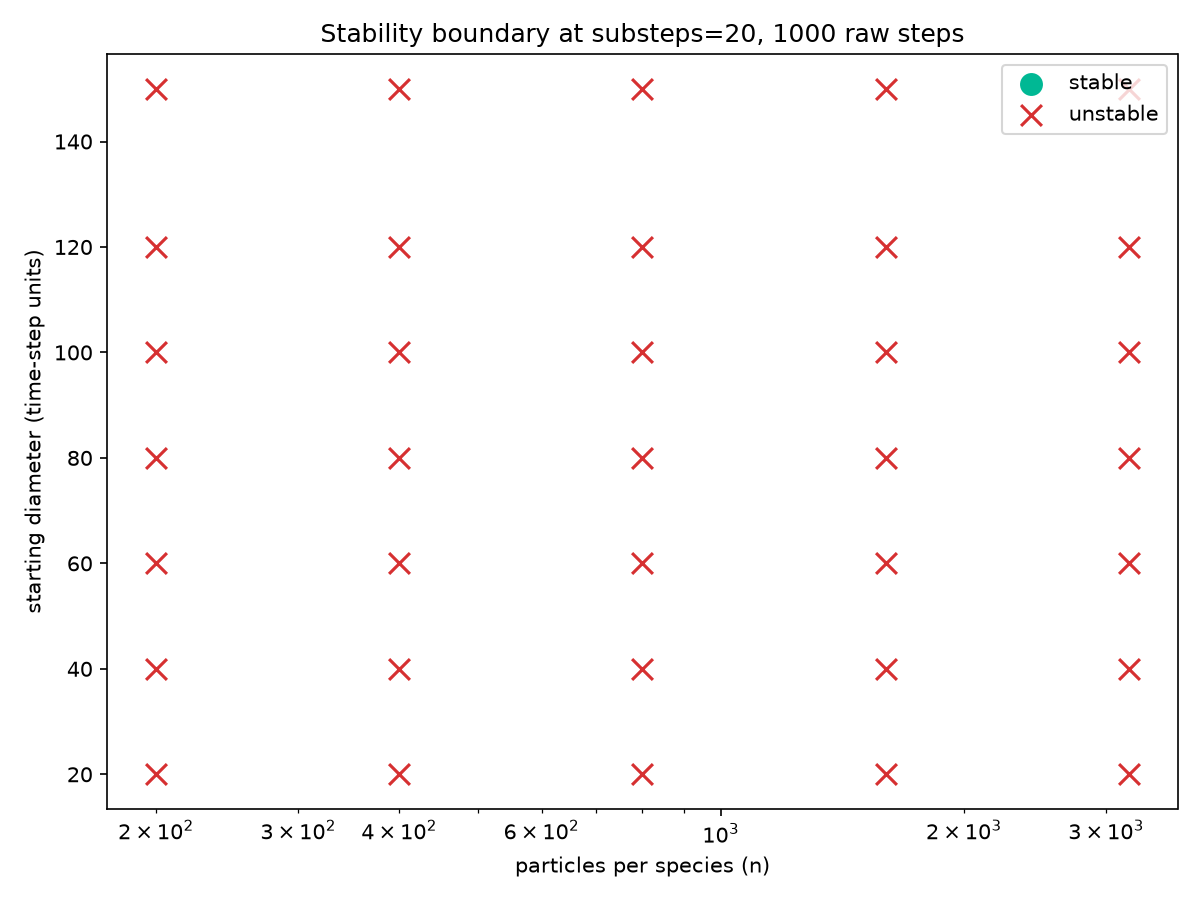
A whole cluster released together never stays bound, at any size tested
The widest stability search run so far - 35 trials spanning 200 to 3,200 particles per species and starting diameters from 20 to 150 - found zero stable configurations. This includes the exact configuration an earlier, lower-resolution run had called stable; a dedicated convergence check confirms the result holds from substeps=10 through 40, so it isn't a resolution artifact. A real, graded pattern survives inside the negative result: larger populations and wider starting diameters both delay dispersal, they just never prevent it. Read alongside the cluster-formation findings below: a whole population launched together disperses, but bound structures still form spontaneously within the resulting chaos.
See the experiment and full analysis →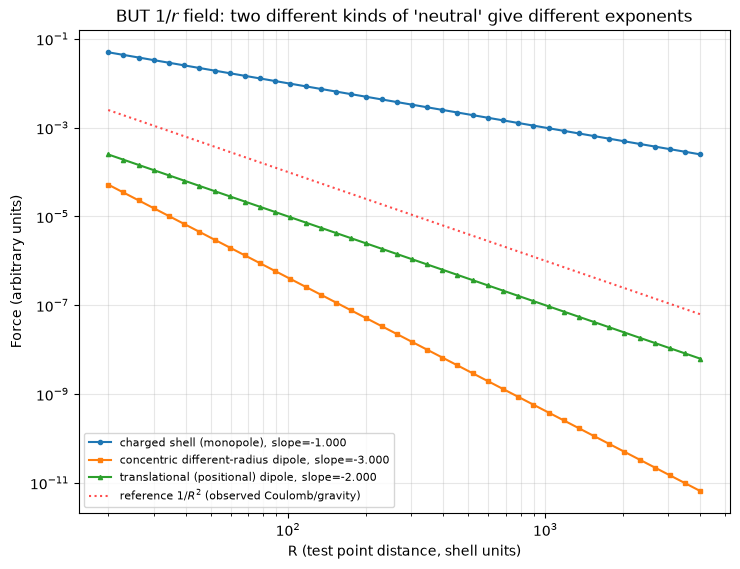
Force-Law Exponent
One neutral source shape recovers the observed 1/R² exactly
Every static charge-neutral source shape tested previously - concentric shells, rings, helices - gave an exponent other than the observed 1/R². A positionally-displaced dipole (same-radius shells, centers offset, the textbook electric-dipole construction) doesn't: fitted exponent -1.99993, matched to 4 decimal places, holding across displacement ratios from 0.001 to 0.9, and independently cross-checked via a completely separate discrete-particle method. This narrows rather than resolves the paper's open exponent problem - it shows the earlier "nothing static works" conclusion was true for the specific shape tested, not for every possible one.
See the experiment and full analysis →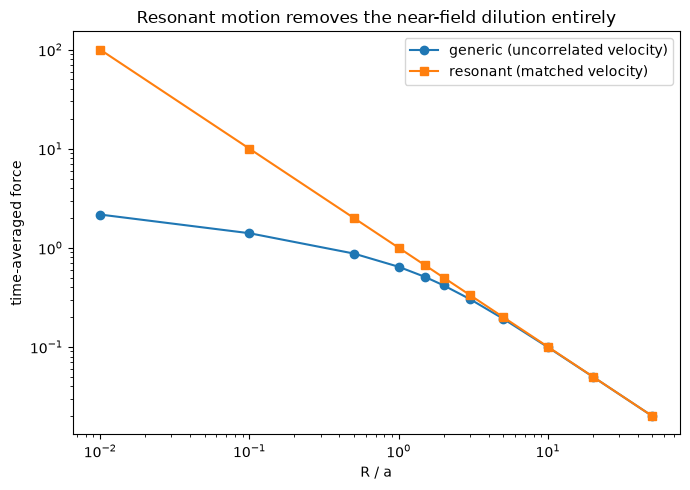
Binding Mechanism
Velocity-matched pairs couple up to 46x more strongly than generic pairs
Every particle in this theory moves at exactly c. Two particles whose motion is closely synchronized barely dilute their mutual force at all - their true separation stays essentially constant, so there's nothing to average away. Generic, uncorrelated pairs dilute their coupling heavily instead. The resonance is sharp: a frequency mismatch of just 1 part in 10,000 collapses the boost from 20x to about 4x. A plausible, mechanistically transparent candidate for why some configurations bind while most chaotic ones don't - though it doesn't by itself resolve the force-law exponent problem above.
See the experiment and full analysis →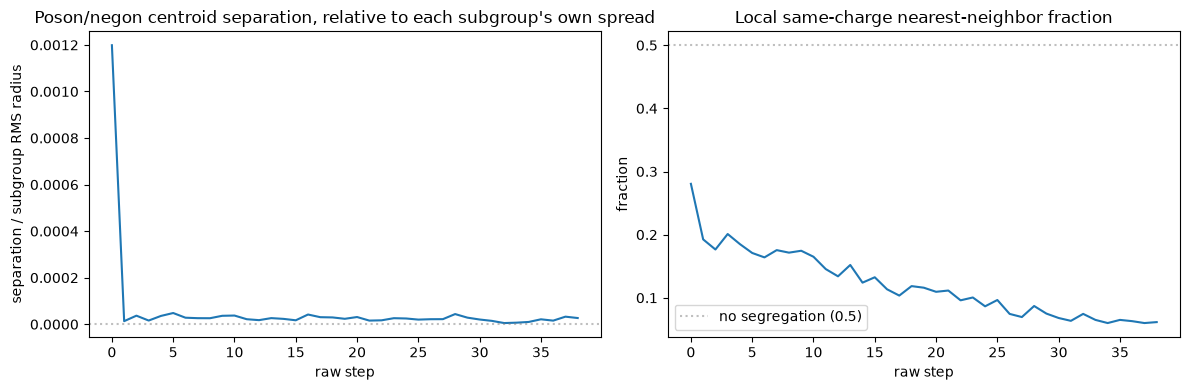
Bound Structure Formation
Over 93% of nearest-neighbor pairs end up opposite-charge
A deep audit of a 200,000-particle run, built to catch false positives in the engine's own stability-detection signals - and it found one: the acceleration signal flagged 99.1% of all particles as "stable" by the end, while the swarm's overall size had simultaneously grown 24.9x. But a real signal survived the audit: the fraction of particles whose nearest neighbor shares their charge fell from 28.1% to 6.3% over the run - genuine local dipole-like pairing, distinct from the false-positive signals around it.
See the experiment and full analysis →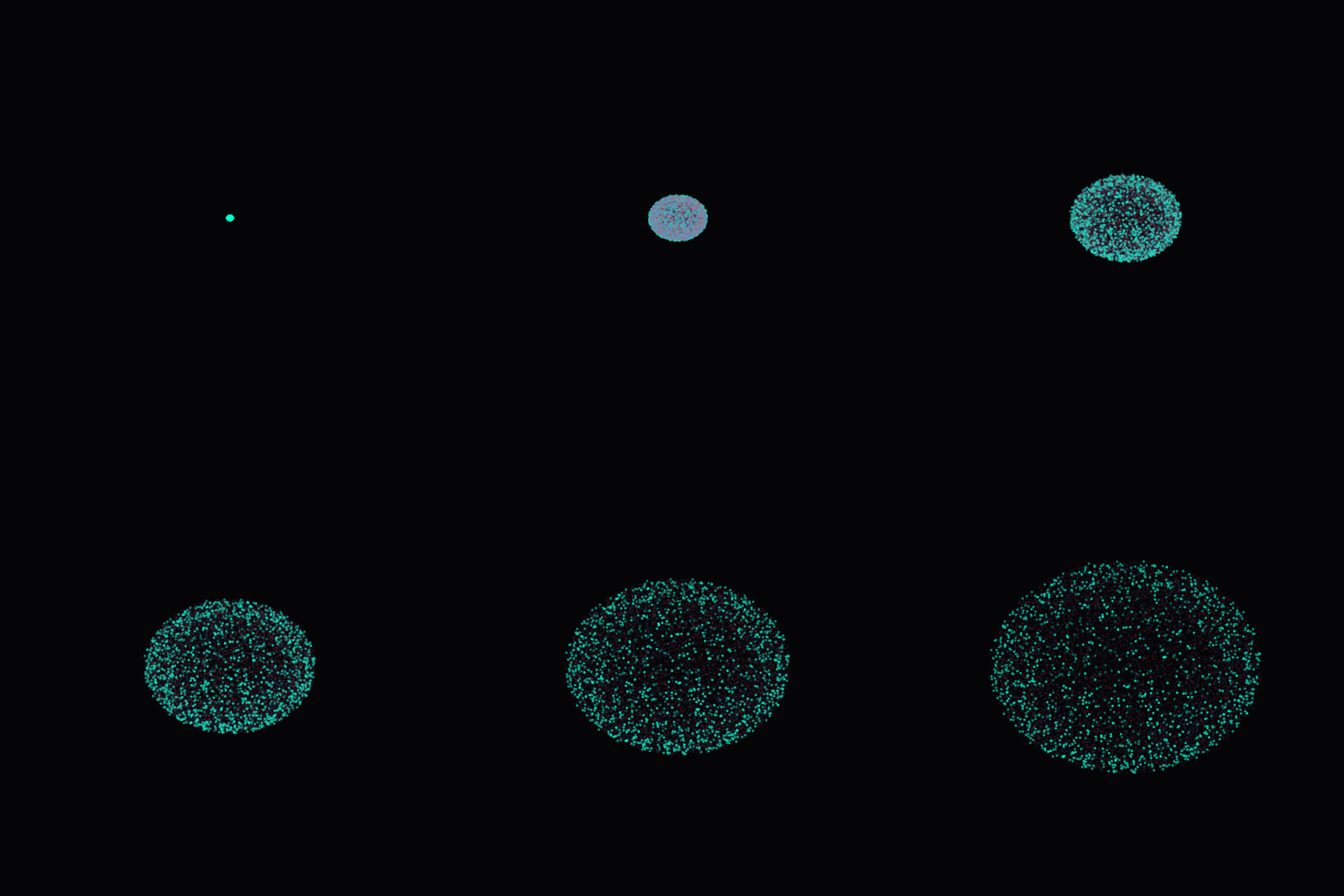
Bound Structure Formation
Under a different integration mode, a connected network spans nearly the whole swarm
Switching to hyperbolic rapidity integration and running 56,000 steps (over 11x longer than the earlier n=100,000 run) produced the largest connected structure found in this project so far: 24,521 particles, 24.5% of the entire swarm - but not as a compact blob. The swarm itself expanded enormously over the run, and this structure's members are spread almost isotropically across that whole expanded volume, linked end-to-end by a continuous chain of local bonds rather than gathered in one place. It was also still growing when the run ended, so this number is a floor, not a settled result. A genuinely different kind of finding from the two runs below - read honestly as a percolating network, not a cluster in the everyday sense of the word.
See the experiment and full analysis →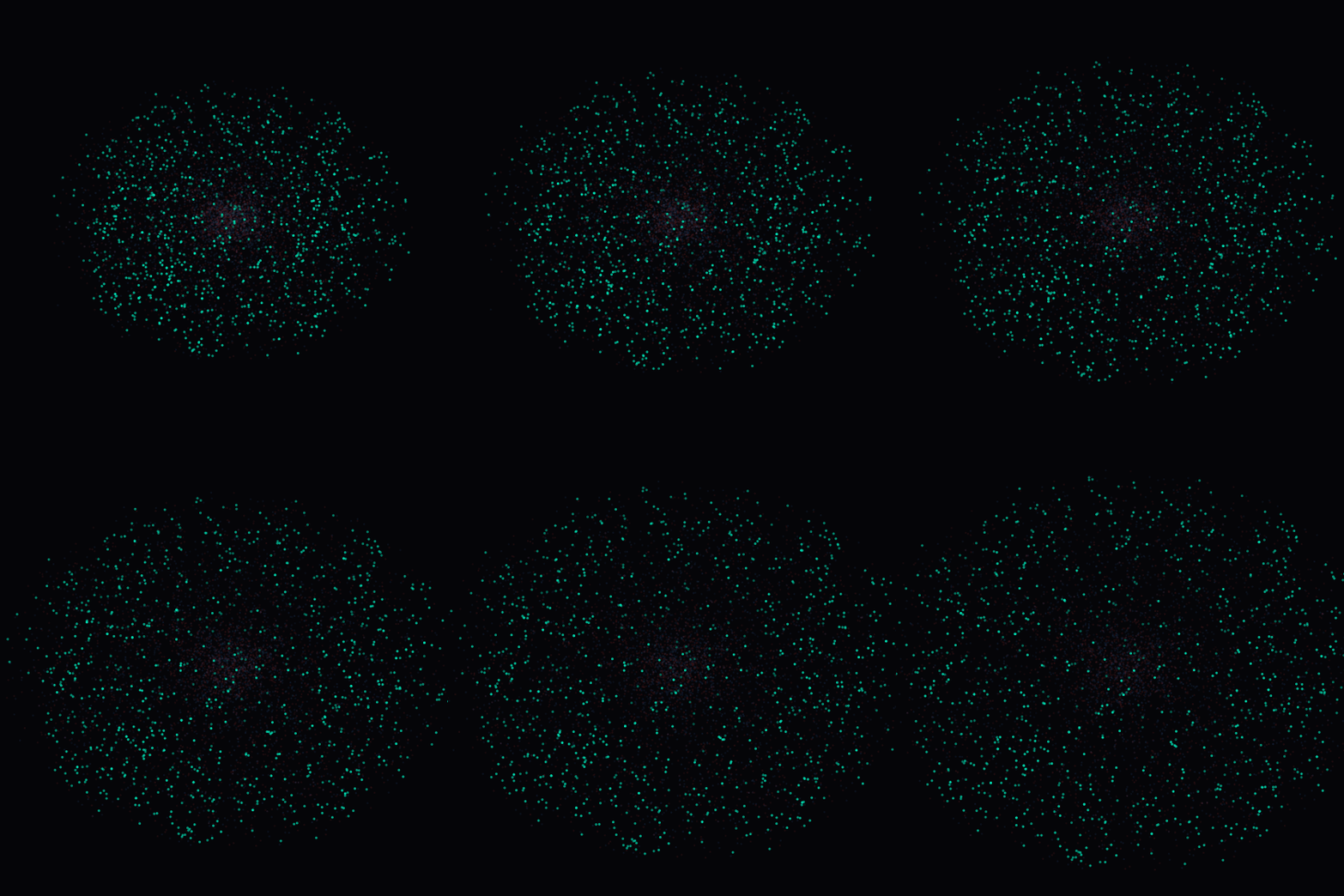
Bound Structure Formation
Over 14% of a swarm bound into one structure - and this time, exactly
A follow-up 100,000-particle run produced an even larger proportional finding: 14,385 particles - over 14% of the entire swarm - bound into a single structure, more than double the population share of the earlier 250,000-particle result. This run used the engine's new cluster event capture feature, so every particle ID here is exact, tracked live by the engine itself, not reconstructed after the fact. The structure's character is also different: large and diffuse rather than small and tight - a real, open question about why, not yet answered.
See the experiment and full analysis →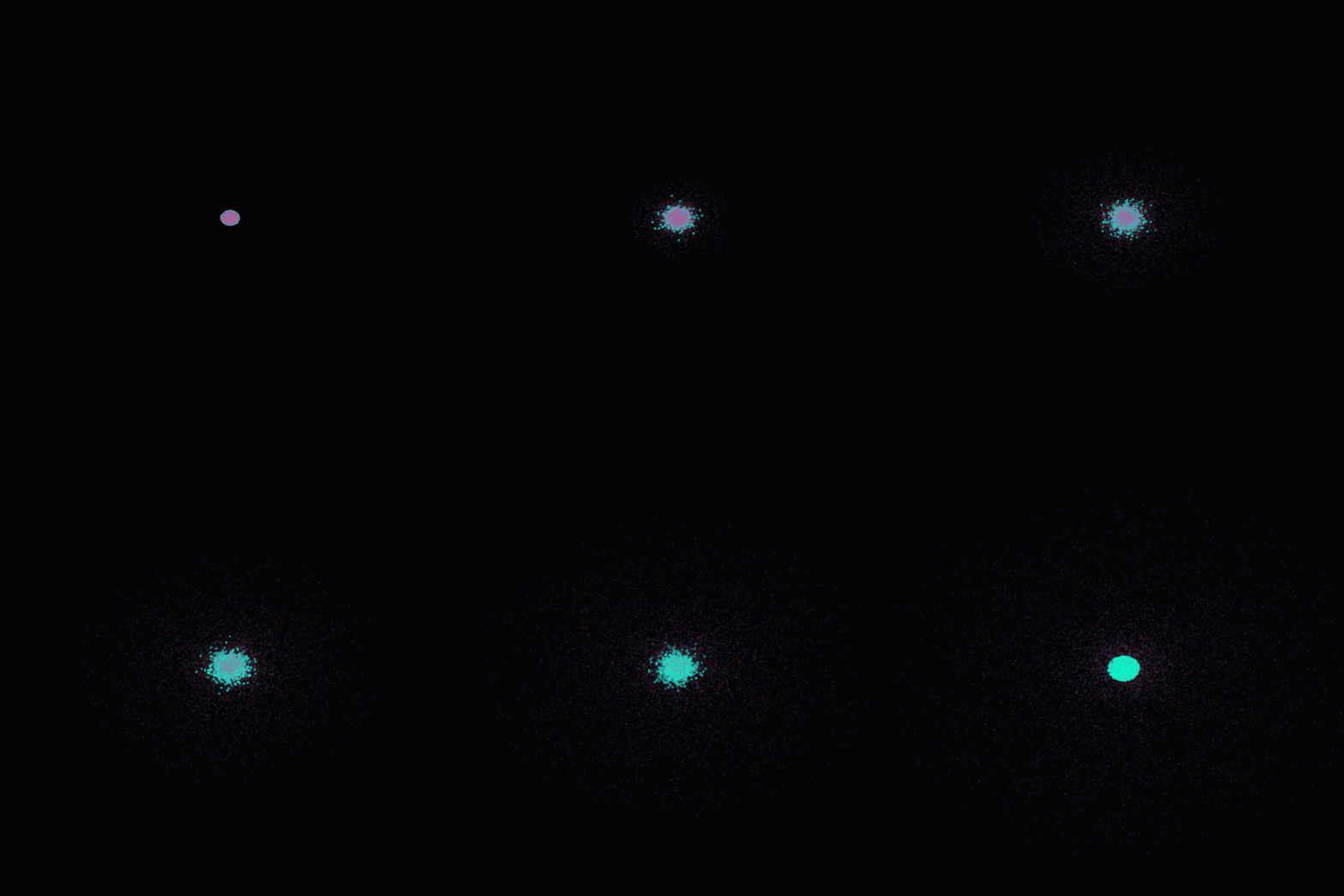
Bound Structure Formation
A quarter-million particles, and one structure held together
In a real 250,000-particle run, a single cluster of 12,472 particles - about 5% of the entire swarm - formed and persisted, tracked back to when its members were still scattered throughout the diffuse cloud. It's the largest bound structure found in any run so far at the time, and a concrete example of the kind of spontaneous binding this project's stability signals were built to catch.
See the experiment and full analysis →More observations are added as they're found - this page grows with the experiments.