Velocity-Matched Pairs Reach 46x the Coupling of Generic Pairs
Every particle in this theory moves at exactly c. Two particles whose motion happens to be closely synchronized barely dilute their mutual force at all - generic, uncorrelated pairs dilute it heavily.
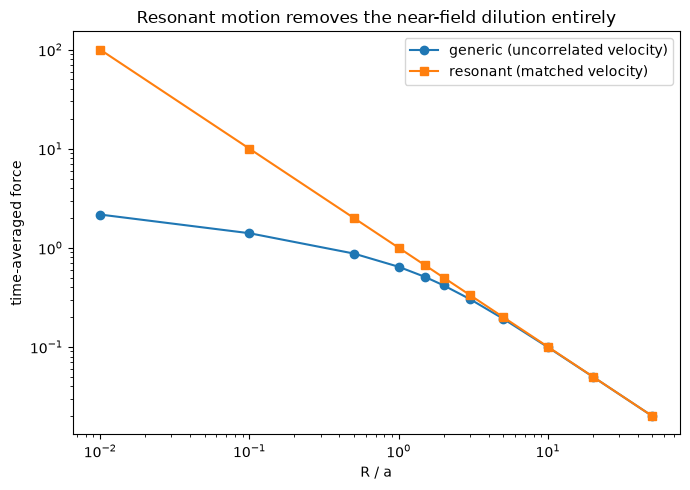
Both curves converge at large separation, but diverge sharply as R/a → 0 - resonant (velocity-matched) coupling reaches 46x the generic value.
What Was Tested
| Method | Time-domain integration of two point particles orbiting at fixed speed c, time-averaging the true instantaneous 1/r force over a full run |
| Generic case | Slightly mismatched orbital frequency (phase sweeps through every relative configuration over the averaging window) - models two unrelated composites |
| Resonant case | Exactly matched frequency, zero phase offset - velocities identical in direction and magnitude at every instant |
| Separation range | R/a from 0.01 to 50 (orbit radius units) |
| Generality check | Repeated for ordinary inverse-square (n=2) as well as BUT's own n=1 law |
Observations
- 46x coupling boost at close range (R/a=0.01) for velocity-matched pairs versus generic pairs - and the mechanism is exact, not approximate: with matched frequency and zero phase offset, the two particles' true separation is mathematically constant (verified directly: min and max separation both exactly 0.05 over a full check window), so there's nothing to dilute in the first place.
- The resonance is sharp, not broad: a frequency mismatch of just 1 part in 10,000 already collapses the boost from 20x down to about 4x; by 1 part in 1,000 it has decayed to the generic baseline. Binding via this mechanism would require velocities matched extremely precisely, not merely similar in rough magnitude and direction.
- Not specific to BUT's force law: repeating the comparison under ordinary inverse-square (n=2) shows the same qualitative resonance (up to 38.9x boost at close range) - this is a general property of near-field time-averaging, not an artifact of the particular power law tested elsewhere in this project.
- The two curves converge exactly at large separation - a distant pair's coupling doesn't care whether their internal motion is correlated, both reduce to the same diluted, shape-governed result found in the companion static-shape notebook (coil/helix sources).
Read honestly: this does not resolve the paper's open problem about recovering the observed 1/R² macroscopic exponent from BUT's fundamental 1/r law. What's recovered here is still fundamentally the 1/r law, evaluated without dilution rather than with it - a statement about coupling strength between specific pairs, not about the exponent of the aggregate force law. It's a plausible, mechanistically transparent candidate for why some configurations bind into stable composites while most chaotic configurations don't (and lines up with the theory's own description of the photon as a maximally-resonant bound pair) - not a claim that the exponent problem is solved.
Go Deeper
The full model, the resonance-sharpness sweep, and the n=2 generality check are available as a rendered notebook.