A Neutral Configuration That Recovers 1/R² Exactly
BUT's fundamental force law is 1/r. Every static, charge-neutral source shape tested so far - shells, rings, helices - gave something other than the observed 1/R². This one doesn't.
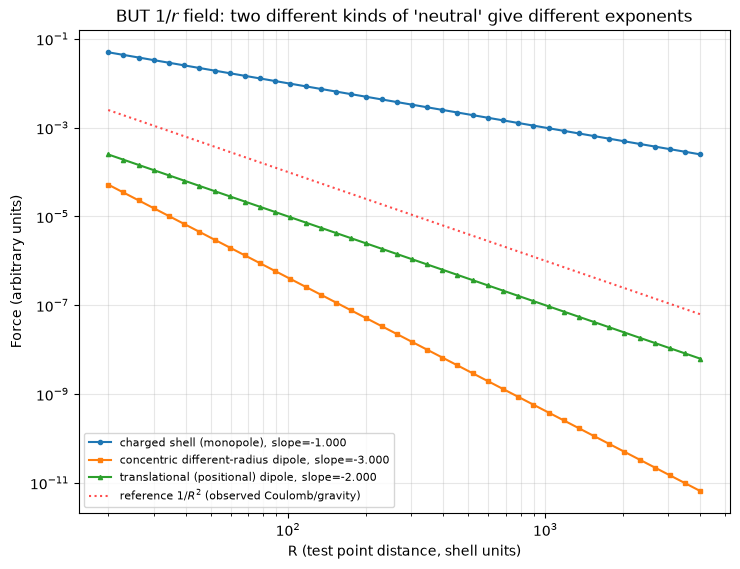
The translational dipole (green) tracks the reference 1/R² line (dotted red) exactly, while the monopole and concentric-shell dipole diverge from it.
What Was Tested
| Method | Numerical shell integration (400,000-point quadrature), plus an independent discrete point-particle cross-check |
| Configuration | Two same-radius, opposite-charge shells with centers displaced by δ (the textbook electric-dipole construction) - distinct from the paper's existing concentric different-radius test |
| Range tested | R from 50 to 3,200 shell radii (main sweep); R from 500 to 50,000 (δ/a robustness sweep) |
| Displacement ratios (δ/a) | 0.001, 0.01, 0.1, 0.3, 0.6, 0.9 |
| Independent cross-check | Discrete N=400-particle-per-sphere brute-force pairwise summation, same computation the Metal engine's force kernel performs |
Observations
- Fitted exponent: -1.99993 (theory: exactly -2) from the continuous shell-integration method - matched to 4 decimal places across a 64x range of test distances.
- Holds across the entire displacement range tested, from δ/a=0.001 out to δ/a=0.9 (centers displaced by 90% of the shell radius) - fitted exponent stays at exactly -2.00000 throughout. This is not a small-displacement idealization that degrades at realistic separations.
- Independently cross-validated: a completely separate method - discrete point-particle clusters (400 particles per sphere) summed pairwise, the same computation the simulation's own GPU kernel performs - gives -1.99992, agreeing with the continuous method to 4 decimal places.
- The mechanism is a calculus distinction, not a coincidence: the existing concentric different-radius test cancels the monopole term in a way that leaves only odd inverse powers of R (so the next term is R⁻³, not R⁻²) - a positional displacement instead acts as a derivative, which shifts the leading power by exactly 1 regardless of what powers exist in the underlying function.
Read honestly: this narrows, rather than resolves, the open problem stated in the paper's Section VII.D. It shows the "no static neutral geometry works" conclusion was true for the specific configuration originally tested (concentric shells of different radius, motivated by BUT's own observed radial charge segregation), not for every static neutral configuration. Whether BUT's actual bound states look more like the concentric core-shell picture or the positional-displacement picture - or something else entirely - is not settled by this notebook. It's a real, robust, independently-verified mathematical result about one specific idealized source shape, not a proof that BUT's real particle swarms produce it.
Go Deeper
The full derivation, the robustness sweep, and the independent discrete-particle cross-check are available as a rendered notebook.