Over 93% of Nearest-Neighbor Pairs End Up Opposite-Charge
A deep-dive audit of a 200,000-particle stability search, built to catch false positives in the engine's own detection signals - which found one, and a real local pairing signal alongside it.
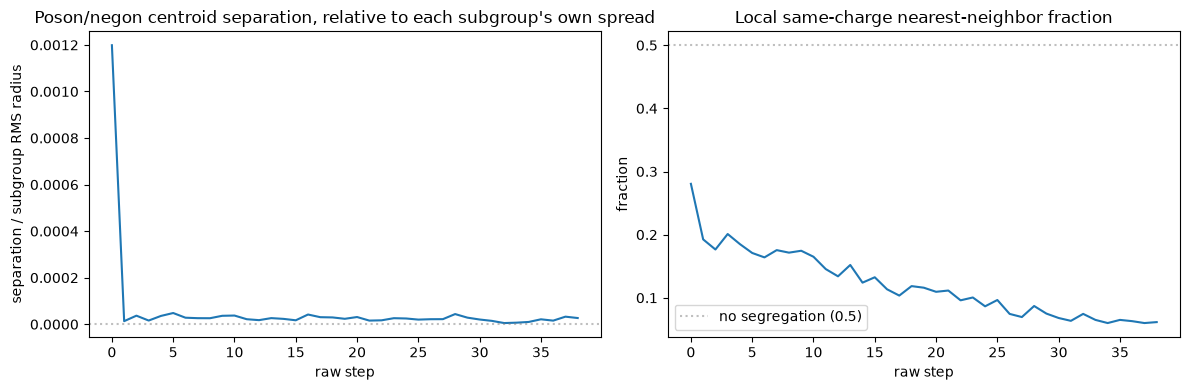
Left: no large-scale charge segregation (the two clouds' centroids stay essentially coincident). Right: a real local pairing signal - the same-charge nearest-neighbor fraction falls well below the 0.5 no-segregation line.
Run Parameters
| Total particles | 200,000 (100,000 posons + 100,000 negons) |
| Integration mode | Direct Normalization |
| Steps completed | 3,800 raw steps (substeps=4), ~3.2 hours |
| Signals audited | Crowding, proximity, acceleration candidate counts |
| Additional checks run | RMS radius trend, charge-centroid separation, local same-charge fraction, velocity polarization, radial coherence |
Observations
- The built-in stability signals were a false positive, confirmed with numbers. By the end of the run, the acceleration signal alone flagged 99.1% of all 200,000 particles as "stable candidates" - while RMS radius (the swarm's overall size) simultaneously grew 24.9x (62.5 → 1557.1). A signal that flags nearly everyone while the whole population is still visibly expanding isn't discriminating anything.
- No large-scale charge segregation: the poson-cloud and negon-cloud centroids stay essentially coincident throughout - separation never exceeds 0.15% of either subgroup's own spread, at every frame checked.
- But a real, striking local pairing signal: the fraction of particles whose nearest neighbor shares their charge drops from 28.1% at step 0 to just 6.3% by the end - meaning over 93% of nearest-neighbor pairs are opposite-charge. Physically sensible (same charge repels, opposite attracts), and distinct from the false-positive signals above.
- Global velocity polarization stays near zero (~0.002-0.008) - the swarm isn't drifting off in one shared direction. But radial coherence climbs from 0.38 to 0.77 - particles increasingly move outward from the swarm's own center together, which is what a self-similarly expanding cloud looks like, not bound orbital structure.
Read honestly: the overall picture here is a swarm settling into an increasingly clean, self-similar ballistic expansion - not forming genuine large-scale bound composite structures. The charge-pairing signal is the one genuinely interesting exception, and this notebook doesn't go the next step of actually finding and tracking individual opposite-charge pairs to see whether any of them stay bound rather than also drifting apart with the general expansion - that's flagged as the natural follow-up, not done here. This finding also predates the substep-resolution fix discussed on the stability-scaling page above; substeps=4 is a real improvement over substeps=1 but wasn't cross-checked at higher resolution the way that later notebook's convergence check was.
Go Deeper
The full audit - including the coldstart-warmup artifact this notebook was specifically built to catch, and the reusable methodology for checking any future run - is available as a rendered notebook.