Stability vs. Particle Count and Starting Diameter
A 35-trial sweep across particle counts from 200 to 3,200 and starting diameters from 20 to 150 - the widest stability search run so far. The result: zero stable configurations, confirmed by a proper resolution convergence check rather than a single pass.
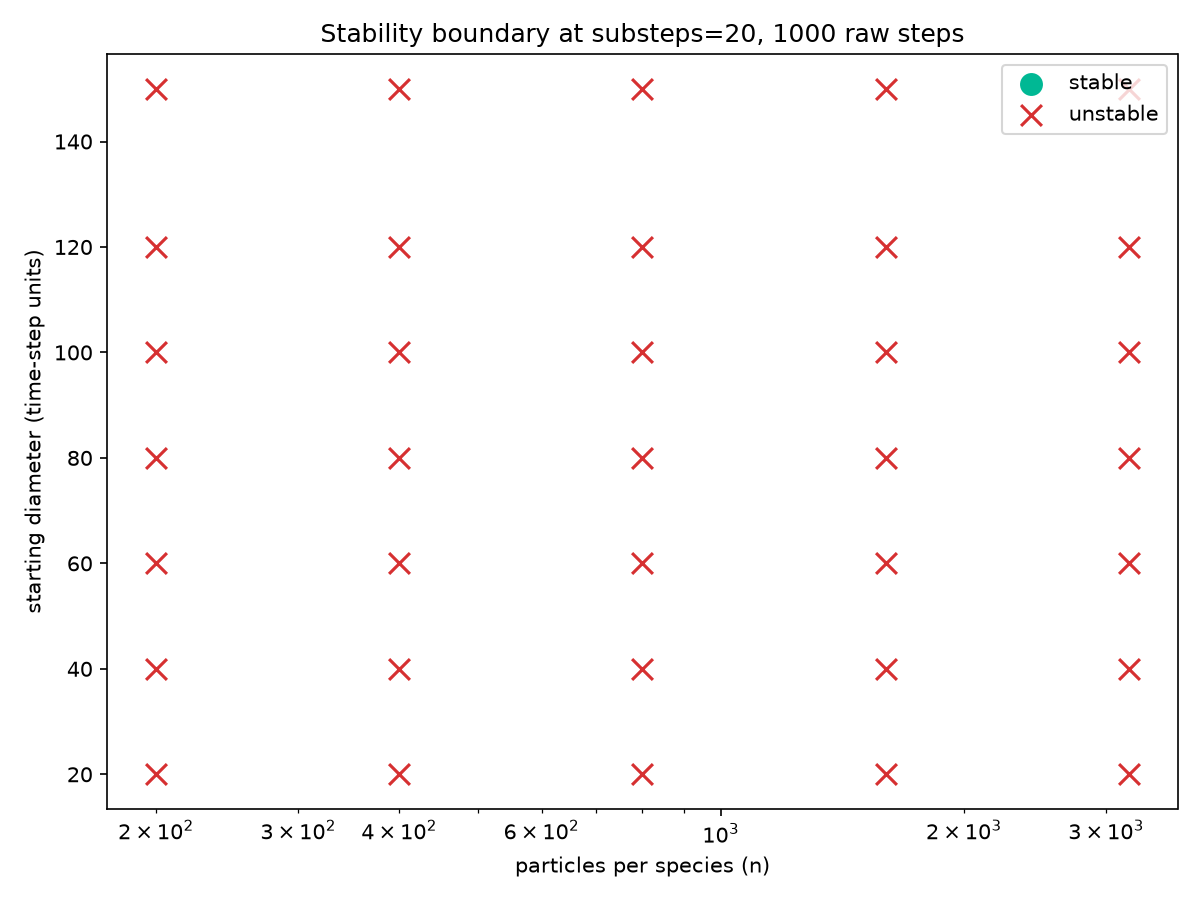
Every one of the 35 (n, diameter) combinations tested came back unstable - no green dots anywhere on the grid.
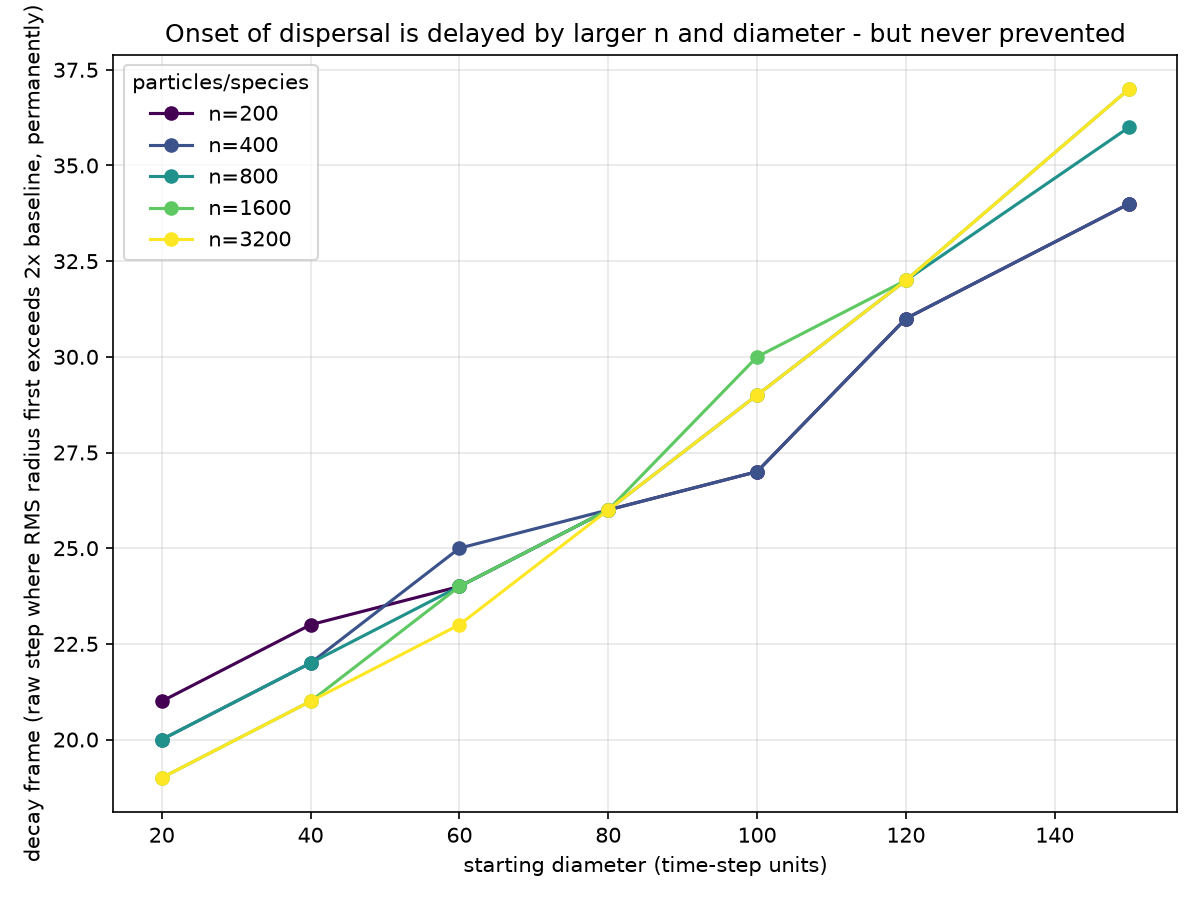
A real, graded signal survives inside the negative result: bigger n and larger starting diameter both delay dispersal - they just never prevent it.
Run Parameters
| Particle counts tested (per species) | 200, 400, 800, 1,600, 3,200 (400-6,400 total particles per trial) |
| Starting diameters tested | 20, 40, 60, 80, 100, 120, 150 (time-step units) |
| Grid size | 35 trials (5 particle counts x 7 diameters) |
| Integration mode | Direct Normalization |
| Force resolution | substeps=20 (main sweep), cross-checked at 1/10/20/40 |
| Run length | 1,000 raw steps per trial |
| Stability definition | RMS radius never permanently exceeds 2x its early-run baseline |
Observations
- 0 of 35 configurations remained bound. This includes the exact n=400/diameter=20 point that originally looked stable in earlier, lower-resolution runs - it doesn't survive proper time-resolution.
- A dedicated convergence check confirms this isn't a resolution artifact. Re-running that same n=400/diameter=20 point at substeps=1, 10, 20, and 40: unstable at every resolution from 10 upward, with the decay step and final spread essentially unchanged between 10, 20, and 40. The classification has converged - it stopped changing.
- The substeps=1 rerun disagreed with itself (a different decay step and final spread than the earlier substeps=1 run that originally called this point "stable") - direct evidence that low-resolution single-seed runs aren't just imprecise, they can contradict each other on the exact same nominal configuration.
- Larger n and larger starting diameter both measurably delay the onset of dispersal (from step ~19-21 at diameter=20 up to step ~34-37 at diameter=150), fairly consistently across every particle count tested - a real relationship, just not the one originally hypothesized.
Read honestly: only one random seed was run per (n, diameter) point in the main sweep - this is an explicitly chaotic system, and the convergence check's own substeps=1 disagreement is direct evidence that seed variance is real here. "Zero stable configurations found" is a strong signal, not a proven ceiling; a multi-seed replication at a few boundary-adjacent points would be the natural next step. Also worth being clear about scope: this tests whether a whole population, released together as one compact group, stays bound as a single unit - it never does here. That's a different question from whether some particles within a much larger, freely-expanding swarm find each other and stay bound, which is exactly what the cluster-formation experiments below found, repeatedly.
Go Deeper
The full notebook - including the pipeline setup, the real 35-trial classification, and the convergence check - is available as a rendered notebook.