Large-Scale Cluster Formation at n=100,000
A single bound structure of 14,385 particles emerged from a 100,000-particle swarm - over 14% of the entire simulation, tracked with exact particle IDs from start to finish.
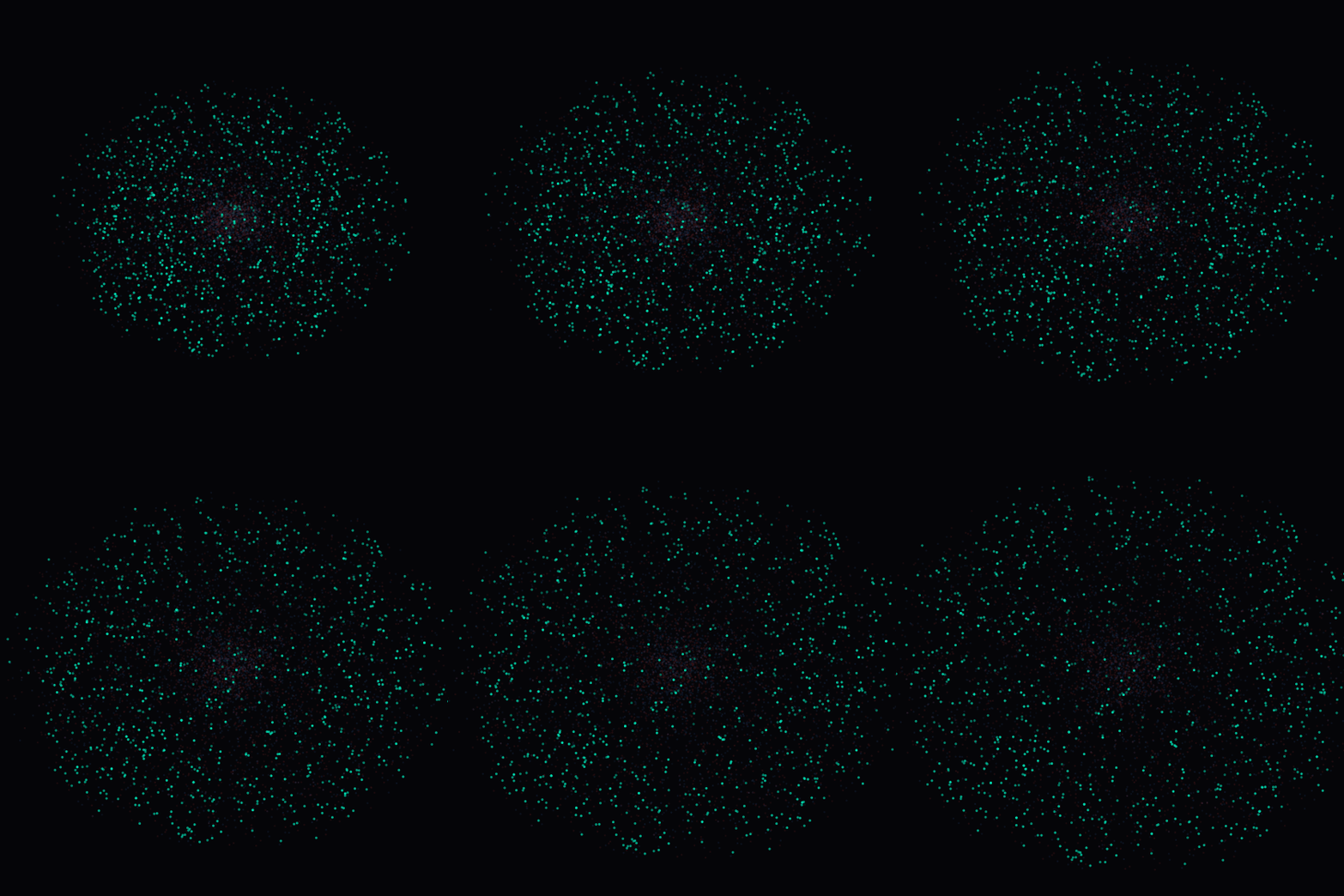
● Posons ● Negons ● the identified 14,385-particle cluster (exact membership, tracked live by the engine itself)
Run Parameters
| Total particles | 100,000 (50,000 posons + 50,000 negons) |
| Initial diameter | 126.0 |
| Integration mode | Direct Normalization |
| Force computation | Brute force (exact, not Barnes-Hut approximated) |
| Signals enabled | Crowding, proximity, acceleration, velocity-matching, cluster identification, cluster event capture |
| Steps completed | 5,000 of 5,000 (full run, ~76 minutes) |
Observations
- The largest structure found anywhere in the run was 14,385 particles - over 14% of the entire swarm - appearing around step 4,730. Proportionally almost three times the ~5% share found in the earlier n=250,000 run.
- Unlike that earlier finding, this cluster is large and diffuse rather than small and tight - it spans much of the swarm's visible extent, not a dense little core. Whether that's run-to-run variation, a genuine effect of the different particle count, or something else entirely is an open question this page doesn't settle.
- This run used the engine's new cluster event capture feature, so - unlike the n=250,000 page - every number and every particle ID here is exact: real, live, cross-step tracking by the engine itself, not a post-hoc reconstruction from nearest-available saved frames.
Read honestly: the clip above samples 34 frames out of 1,508 real captured frames spanning the cluster's full window (steps 3,492-4,999) - real data throughout, just not literally every single step, to keep the file a reasonable size for the web. Also worth knowing: at the point this run ended, this cluster (and in fact all 2,000 clusters captured that run) was still active, not yet settled - the swarm may not have reached a steady state by step 5,000.
Go Deeper
The full analysis - exact cluster tracking, particle IDs with no reconstruction needed, and how this compares to the earlier n=250,000 finding - is available as a rendered notebook.